Cadillac Fairview
A search experience redesigned around the speed brokers need.
Commercial Real Estate
Multi-Persona UX
Constraint-Driven Design
Overview
Finding Space Faster
Design Lead · 2 months · Team of 2 Designers
As design lead, I directed the redesign of Cadillac Fairview's corporate office search experience. CF manages 28 million square feet of leasable space across Canada, with $26 billion in assets under management.
The existing search experience was failing its most critical users. Brokers depend on matching clients to space in hours, not days. But the interface made it hard to answer basic questions about unit availability, unit resources, and whether adjacent suites could be combined into a single larger space.
CF's executive leadership engaged us to optimize the end-to-end journey for three distinct personas: prospective tenants, current tenants, and the brokers who drive deals. The work had to live inside an existing design system the client asked us to make minimal changes to.
The Challenge
Understanding the Friction
In commercial real estate, speed is the product. Realtors who find the right space first win the deal. CF's search experience was slowing them down in three specific ways.
We combined CF's institutional knowledge with direct conversations with their head of broker relations and a broker representative who joined our working sessions. Three friction points shaped everything that followed.

Death by a thousand taps
Brokers move fast. When a tenant needs space, the window to make a match is narrow. The existing experience buried critical unit information inside a modal, and promised resources like floor plans that didn't exist for all units. This forced brokers to tap through just to discover what was missing.

Tenants took the long way home
Current tenants had no clear path to their own building page. The homepage pushed everyone into a prospective-tenant search flow, forcing existing tenants to look up their own office through a tool built for people shopping for space. A dedicated tenant entry point existed, but it sat below the fold where most users never found it.
Contiguous units were invisible
When tenants needed more space than a single unit provided, brokers had to hunt for adjacent suites manually, cross-referencing floor plans and calling building management to confirm which units sat side by side. The product had no way to surface these combinations, and larger deals slipped through.
Reducing Friction
Designed for Speed
In the original experience, unit resources were buried inside a modal. Brokers tapped in only to discover what they needed wasn't there.
We surfaced suite sheets, floor plans, and 360 tours as icons directly in the search results. The map, previously shown by default, was moved behind a toggle screen giving space back to what brokers actually came for.
Before
After
Routing by Intent
Sending Tenants Home
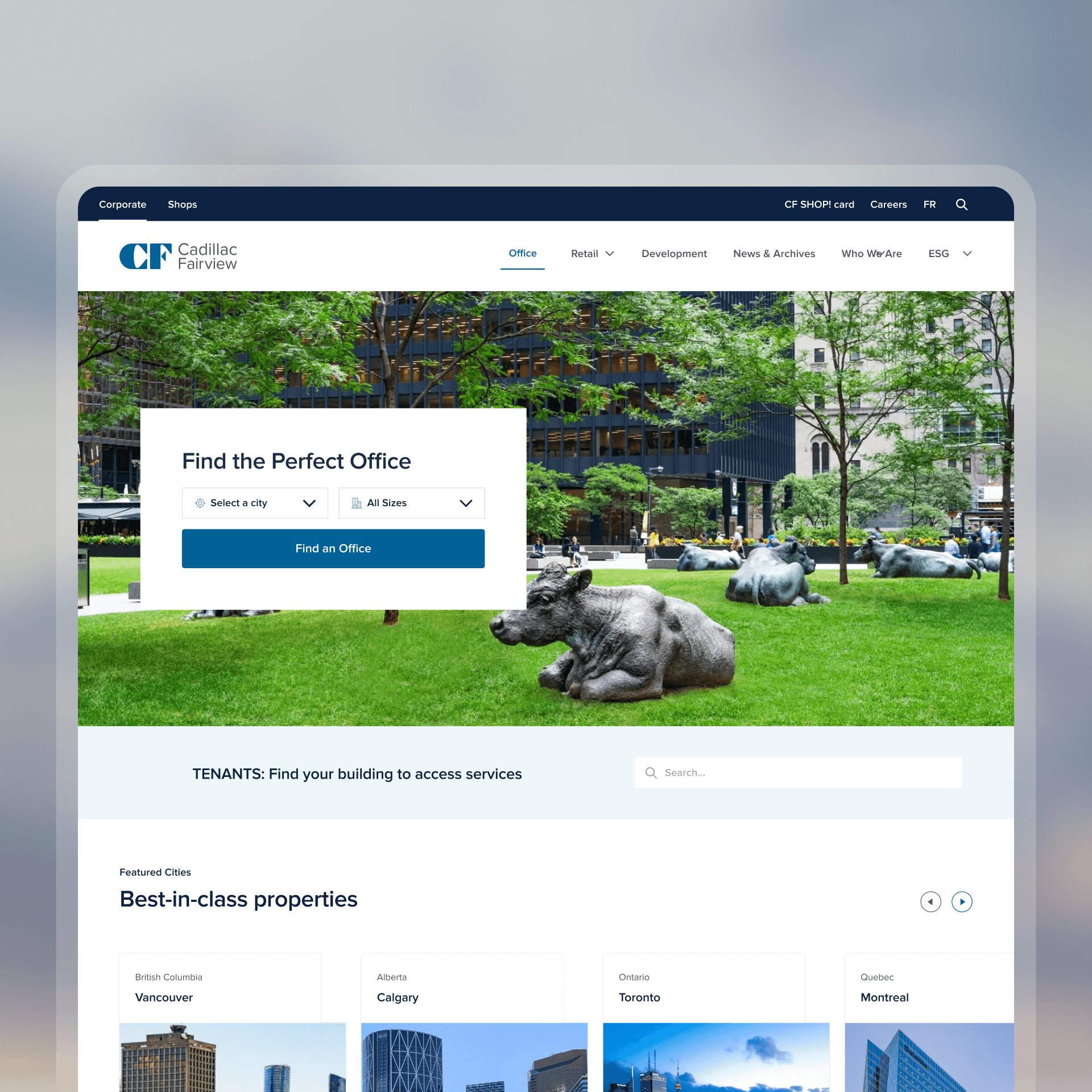
While auditing the broader experience, I noticed the homepage was routing everyone through the same front door. Current tenants were using the search tool built for brokers to look up their own building, and dropping off when it didn't behave the way they expected.
A tenant search pathway existed, but it sat below the fold where most users never reached it.
We pitched a full homepage redesign, creating two clear funnels for current tenants and brokers. The client didn't bite at first, but after aligning on the rest of the user experience, we were able to convince the team to allow for a redesign of the hero section to give each persona their own clear search pathway.
Before
After
Hidden Deals
When One Unit Isn't Enough
Contiguous units were the hardest thing to solve. The client asked us not to redesign the search flow or significantly alter the design system, which meant the answer had to live inside the table brokers were already using.
Our solution was adding a toggle to the search filters. When switched on, any units in the results that sit next to each other are wrapped in a single card showing their combined square footage. Brokers see the larger space at a glance without having to piece it together themselves, and prospective tenants browsing on their own aren't shown a concept they don't need.
Before
After
Reflections
Three Takeaways
Every project teaches you something about the work. The ones worth remembering teach you something about how to work.

Constraints are a brief
A locked design system means every concept survives a harder filter. Some good ideas don't make it through. But the constraint shortens the distance between ideation and alignment, which on a project with this many stakeholders, was worth more than the creative freedom we gave up.

Good enough isn't done
The contiguous units solution was right for this project. It worked inside the system, it shipped, and it solved the core problem. But I'd keep exploring given more time. Shipping the right answer for the situation isn't the same as finding the best possible answer.

Scope is the floor
The homepage fix wasn't in the original brief. I caught it mid-project and made the case to fold it in. When you're optimising one part of an existing experience, the rest of the ecosystem doesn't pause to wait for you. Expanding scope is a real cost, but surfacing a gap and letting the team decide is always the right call.
Additional Work
Kea Legard
©2026
Cadillac Fairview
A search experience redesigned around the speed brokers need.
Commercial Real Estate
Multi-Persona UX
Constraint-Driven Design
Overview
Finding Space Faster
Design Lead · 2 months · Team of 2 Designers
As design lead, I directed the redesign of Cadillac Fairview's corporate office search experience. CF manages 28 million square feet of leasable space across Canada, with $26 billion in assets under management.
The existing search experience was failing its most critical users. Brokers depend on matching clients to space in hours, not days. But the interface made it hard to answer basic questions about unit availability, unit resources, and whether adjacent suites could be combined into a single larger space.
CF's executive leadership engaged us to optimize the end-to-end journey for three distinct personas: prospective tenants, current tenants, and the brokers who drive deals. The work had to live inside an existing design system the client asked us to make minimal changes to.
The Challenge
Understanding the Friction
In commercial real estate, speed is the product. Realtors who find the right space first win the deal. CF's search experience was slowing them down in three specific ways.
We combined CF's institutional knowledge with direct conversations with their head of broker relations and a broker representative who joined our working sessions. Three friction points shaped everything that followed.
Death by a thousand taps
Brokers move fast. When a tenant needs space, the window to make a match is narrow. The existing experience buried critical unit information inside a modal, and promised resources like floor plans that didn't exist for all units. This forced brokers to tap through just to discover what was missing.
Tenants took the long way home
Current tenants had no clear path to their own building page. The homepage pushed everyone into a prospective-tenant search flow, forcing existing tenants to look up their own office through a tool built for people shopping for space. A dedicated tenant entry point existed, but it sat below the fold where most users never found it.
Contiguous units were invisible
When tenants needed more space than a single unit provided, brokers had to hunt for adjacent suites manually, cross-referencing floor plans and calling building management to confirm which units sat side by side. The product had no way to surface these combinations, and larger deals slipped through.
Reducing Friction
Designed for Speed
In the original experience, unit resources were buried inside a modal. Brokers tapped in only to discover what they needed wasn't there.
We surfaced suite sheets, floor plans, and 360 tours as icons directly in the search results. The map, previously shown by default, was moved behind a toggle screen giving space back to what brokers actually came for.
Before
After
Routing by Intent
Sending Tenants Home
While auditing the broader experience, I noticed the homepage was routing everyone through the same front door. Current tenants were using the search tool built for brokers to look up their own building, and dropping off when it didn't behave the way they expected.
A tenant search pathway existed, but it sat below the fold where most users never reached it.
We pitched a full homepage redesign, creating two clear funnels for current tenants and brokers. The client didn't bite at first, but after aligning on the rest of the user experience, we were able to convince the team to allow for a redesign of the hero section to give each persona their own clear search pathway.
Before
After
Hidden Deals
When One Unit Isn't Enough
Contiguous units were the hardest thing to solve. The client asked us not to redesign the search flow or significantly alter the design system, which meant the answer had to live inside the table brokers were already using.
Our solution was adding a toggle to the search filters. When switched on, any units in the results that sit next to each other are wrapped in a single card showing their combined square footage. Brokers see the larger space at a glance without having to piece it together themselves, and prospective tenants browsing on their own aren't shown a concept they don't need.
Before
After
Reflections
Three Takeaways
Every project teaches you something about the work. The ones worth remembering teach you something about how to work.
Constraints are a brief
A locked design system means every concept survives a harder filter. Some good ideas don't make it through. But the constraint shortens the distance between ideation and alignment, which on a project with this many stakeholders, was worth more than the creative freedom we gave up.
Good enough isn't done
The contiguous units solution was right for this project. It worked inside the system, it shipped, and it solved the core problem. But I'd keep exploring given more time. Shipping the right answer for the situation isn't the same as finding the best possible answer.
Scope is the floor
The homepage fix wasn't in the original brief. I caught it mid-project and made the case to fold it in. When you're optimising one part of an existing experience, the rest of the ecosystem doesn't pause to wait for you. Expanding scope is a real cost, but surfacing a gap and letting the team decide is always the right call.
Additional Work
Kea Legard
©2026
Cadillac Fairview
A search experience redesigned around the speed brokers need.
Commercial Real Estate
Multi-Persona UX
Constraint-Driven Design
Overview
Finding Space Faster
Design Lead · 2 months · Team of 2 Designers
As design lead, I directed the redesign of Cadillac Fairview's corporate office search experience. CF manages 28 million square feet of leasable space across Canada, with $26 billion in assets under management.
The existing search experience was failing its most critical users. Brokers depend on matching clients to space in hours, not days. But the interface made it hard to answer basic questions about unit availability, unit resources, and whether adjacent suites could be combined into a single larger space.
CF's executive leadership engaged us to optimize the end-to-end journey for three distinct personas: prospective tenants, current tenants, and the brokers who drive deals. The work had to live inside an existing design system the client asked us to make minimal changes to.
The Challenge
Understanding the Friction
In commercial real estate, speed is the product. Realtors who find the right space first win the deal. CF's search experience was slowing them down in three specific ways.
We combined CF's institutional knowledge with direct conversations with their head of broker relations and a broker representative who joined our working sessions. Three friction points shaped everything that followed.
Death by a thousand taps
Brokers move fast. When a tenant needs space, the window to make a match is narrow. The existing experience buried critical unit information inside a modal, and promised resources like floor plans that didn't exist for all units. This forced brokers to tap through just to discover what was missing.
Tenants took the long way home
Current tenants had no clear path to their own building page. The homepage pushed everyone into a prospective-tenant search flow, forcing existing tenants to look up their own office through a tool built for people shopping for space. A dedicated tenant entry point existed, but it sat below the fold where most users never found it.
Contiguous units were invisible
When tenants needed more space than a single unit provided, brokers had to hunt for adjacent suites manually, cross-referencing floor plans and calling building management to confirm which units sat side by side. The product had no way to surface these combinations, and larger deals slipped through.
Reducing Friction
Designed for Speed
In the original experience, unit resources were buried inside a modal. Brokers tapped in only to discover what they needed wasn't there.
We surfaced suite sheets, floor plans, and 360 tours as icons directly in the search results. The map, previously shown by default, was moved behind a toggle screen giving space back to what brokers actually came for.
Before
After
Routing by Intent
Sending Tenants Home
While auditing the broader experience, I noticed the homepage was routing everyone through the same front door. Current tenants were using the search tool built for brokers to look up their own building, and dropping off when it didn't behave the way they expected.
A tenant search pathway existed, but it sat below the fold where most users never reached it.
We pitched a full homepage redesign, creating two clear funnels for current tenants and brokers. The client didn't bite at first, but after aligning on the rest of the user experience, we were able to convince the team to allow for a redesign of the hero section to give each persona their own clear search pathway.
Before
After
Hidden Deals
When One Unit Isn't Enough
Contiguous units were the hardest thing to solve. The client asked us not to redesign the search flow or significantly alter the design system, which meant the answer had to live inside the table brokers were already using.
Our solution was adding a toggle to the search filters. When switched on, any units in the results that sit next to each other are wrapped in a single card showing their combined square footage. Brokers see the larger space at a glance without having to piece it together themselves, and prospective tenants browsing on their own aren't shown a concept they don't need.
Before
After
Reflections
Three Takeaways
Every project teaches you something about the work. The ones worth remembering teach you something about how to work.
Constraints are a brief
A locked design system means every concept survives a harder filter. Some good ideas don't make it through. But the constraint shortens the distance between ideation and alignment, which on a project with this many stakeholders, was worth more than the creative freedom we gave up.
Good enough isn't done
The contiguous units solution was right for this project. It worked inside the system, it shipped, and it solved the core problem. But I'd keep exploring given more time. Shipping the right answer for the situation isn't the same as finding the best possible answer.
Scope is the floor
The homepage fix wasn't in the original brief. I caught it mid-project and made the case to fold it in. When you're optimising one part of an existing experience, the rest of the ecosystem doesn't pause to wait for you. Expanding scope is a real cost, but surfacing a gap and letting the team decide is always the right call.
Additional Work
©2026